- Home
- Market
What is actually
moving price here.
Not interest rates, mostly. On this water the numbers that decide a deal are an insurance quote, a seawall estimate, a finished-floor elevation and the clearance under one bridge.
0
County median days
All Hillsborough residential
0
Our median days
Across the estates we represent
0%
Achieved of asking
Average, 2025 closings
$0M
Average sale price
Trailing twelve months
Figures reflect transactions closed by Aveline & Roan principals. This is a fictional demonstration business; no figures represent real transactions.
One
Carrying cost has replaced the down payment as the hard conversation.
Five years ago a buyer at this level asked what the house cost. Now the second question, before the tour is over, is what it costs to insure and what the seawall behind it will need.
Both have moved sharply. Wind and flood together on an unelevated 1990s waterfront house of six or seven thousand square feet is no longer a rounding error against the mortgage; on several files we have worked this year it has been the single line item that reset the offer. Buyers now routinely bind a quote before the inspection period ends rather than after, and we have started asking sellers for their current declarations page on day one, because it will surface eventually and it is better to price it in than to renegotiate around it.
Seawalls do the same thing in larger increments. A tie-back repair on a sound wall runs in the tens of thousands. A full replacement on a hundred-odd feet of frontage, with the permitting and the barge, has crossed into six figures on every quote we have seen since 2023. That number does not split the difference in negotiation — it comes off the price almost dollar for dollar, because the buyer is going to write the cheque either way.
The market consequence is a widening spread. A 2019 house with poured concrete, impact glass and an engineered wall trades at a premium that has less to do with taste than with the twenty-year cost of ownership. The 1994 house two doors down, beautiful and unelevated, sits.
Two
The elevation certificate is now the first document, not the last.
Every waterfront parcel in these three neighborhoods sits in a mapped flood zone, and the difference between two houses on the same street is measured in inches of finished-floor elevation. We ask for the certificate before we ask for anything else. If there is not one on file, we order it, and we tell the seller what it is likely to say before we agree a price.
The reason is the substantial-improvement threshold. Once the cost of a renovation passes half the structure's assessed value, the whole building has to be brought up to current elevation requirements — which on a 1920s slab-on-grade house means lifting it or rebuilding it. Plenty of otherwise sensible purchase plans die on that line. A buyer intending a $900,000 renovation of a $1.6M structure is not renovating; they are triggering a rebuild, and they should know that in week one rather than in permitting.
Where it cuts the other way is new construction. Houses built to post-2018 code sit high, dry and insurable, and their owners have begun to price that advantage explicitly. We now put finished-floor elevation in the second line of the offering summary, next to the square footage. Three years ago nobody asked.
Three
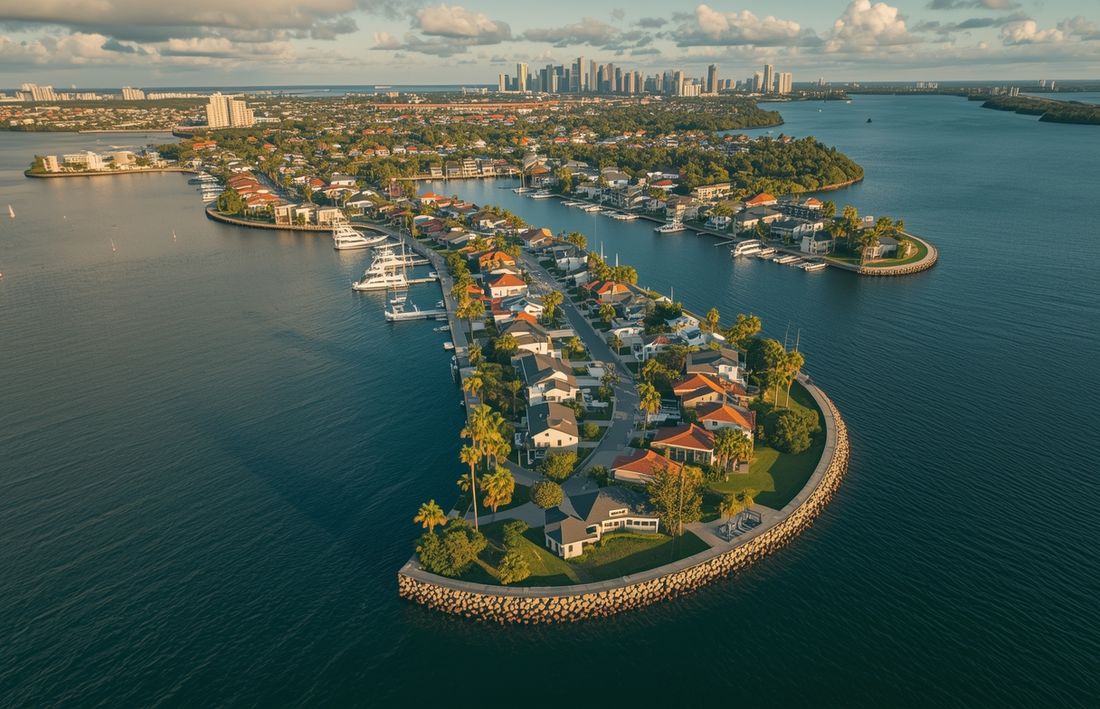
Deep water with no fixed bridges is the last genuinely scarce thing.
Square footage can be added. A dock can be rebuilt, a kitchen redone, a lot replanted. What cannot be manufactured is a channel that holds six feet at mean low tide and runs to open water without passing under something.
The count of parcels that qualify in this market is small and fixed, and the premium attached to them has widened every year since 2019 — most visibly since a run of larger sport-fishing and cruising hulls arrived in the bay, none of which clear a fixed bridge. When we price a waterfront estate the first three questions are depth at low tide, clearance between the dock and the bay, and whether the seawall and lift are permitted for what is actually tied to them. A house with all three answers right will hold its price through a soft quarter. A house with a beautiful view and eleven feet of clearance will not, no matter what the comparables on the same street say.
It also explains an oddity in the data. Two houses of identical size a quarter mile apart on the islands can trade twenty per cent apart, and neither price is wrong. One of them can leave.
Four
Why the historic houses take four times as long to sell.
The county median is 47 days. Split it by vintage and the number stops being one number at all.
New-build waterfront moves quickly because it can be underwritten quickly: the elevation is documented, the insurance is quotable in an afternoon, the warranty is intact, and there is nothing behind the drywall that a buyer has to guess at. Those files close in the low double digits of days when they are priced correctly.
A 1925 Hyde Park house is a different exercise. The buyer pool is narrower to begin with, and each of them arrives with a contractor, a preservation question and an insurer who wants to know about the wiring, the roof deck and whether the original windows are still in place. Add the architectural review that governs any visible exterior change in the district and the diligence period stretches. That is not a defect in the market; it is the market pricing genuine uncertainty.
What shortens it is preparation. On the historic files we take, the permit history, the roof documentation, the insurance history and a measured plan are in the buyer's hands on the first visit. Our median of eleven days is not a negotiating technique. It is mostly the diligence being done before the sign goes up rather than after.